Features
Tudor at Spurs, one match from the trapdoor
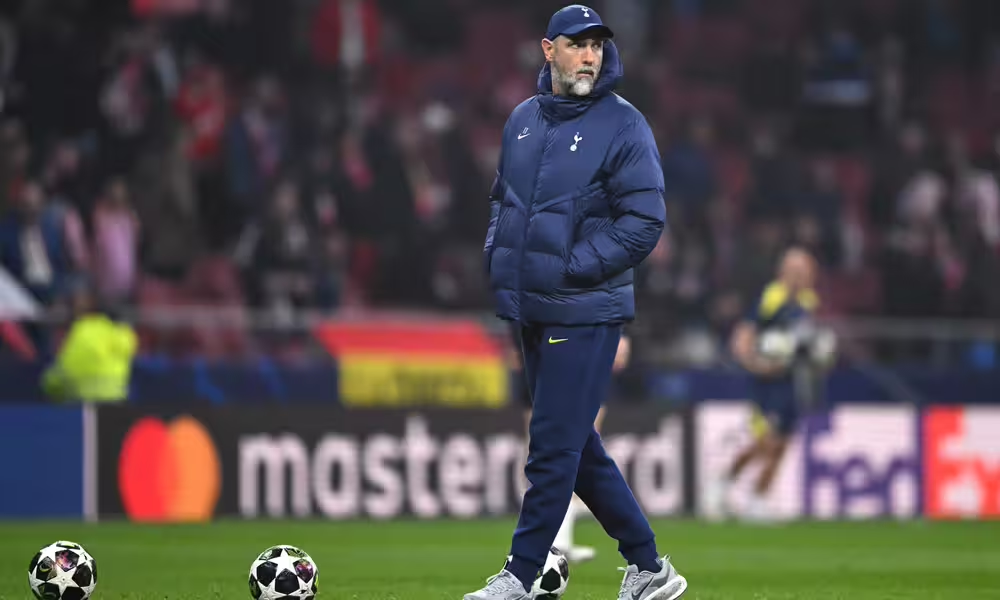
Tottenham have stopped pretending this is a gentle bedding-in period for Igor Tudor. They have openly described his tenure as “at serious risk”.

The club has already said the quiet part out loud
Tottenham have stopped pretending this is a gentle bedding-in period for Igor Tudor. They have openly described his tenure as “at serious risk” and, once a club uses language that stark, the air changes. It is no longer a conversation about tweaks, or patience, or process. It becomes a countdown, a public one, and every training session starts to feel like a prelude to a decision that has already been drafted.
The mood around the betting community is sharper than it used to be, less romantic about a “new manager bounce” and more forensic about what comes next. You can feel it in the way people talk about Spurs now, like they are reading a balance sheet rather than watching a football team. This is what happens when a club signals vulnerability in plain terms, it invites judgment from every angle.
Four defeats, fourteen conceded, and a collapse that lingered
The results under Tudor have been grim: four defeats in charge and 16 goals conceded. Numbers like that do not sit quietly in the background, they shout. A defence can look disorganised for a week, it can even have a bad month, but when the concession tally starts stacking up so quickly it becomes a story of its own, the kind that swallows everything else.
Then there was the 5-2 collapse against Atlético Madrid, the sort of scoreline that doesn’t merely sting, it leaves a stain. Heavy defeats do strange things. They make players look smaller, they make a manager look like he has lost the room, and they make every subsequent mistake feel like proof rather than an accident. The criticism has not been limited to tactics either, because reports say his man-management has drawn sharp scrutiny. That is the dangerous category of complaint, the one that suggests a deeper fracture than a wrong substitution.
He will face the press on Friday, because football loves ritual
Despite all this, Tudor is still expected to address the press on Friday. That detail matters, not because a press conference changes results, but because clubs often use these moments as a temperature check. Sometimes they wheel a manager out because they are backing him. Sometimes they do it because they have not yet decided, and they want to see how he carries himself under pressure, what he says, what he refuses to say.
There is also a bleak normality to it. Football is full of rituals that continue even when everyone suspects the ending. The manager does media. The club releases training photos. Someone talks about “togetherness”. The match arrives anyway, indifferent to the noise around it. And then, if the result goes the wrong way, the rituals stop overnight, as if they never mattered.
Insiders and pundits are already talking like it is nearly over
The consensus among insiders and pundits is that Tudor’s chances of surviving to the season’s end are very slim. That is not the same as certainty, but it is close enough to shape reality. When enough connected voices start leaning in one direction, the manager’s authority erodes in tiny, corrosive ways. Players hear it. Staff hear it. Fans hear it. The board hears it too, and boards hate being made to look slow.
It is also a simple arithmetic problem. Four defeats in charge, 14 conceded, and a high-profile collapse, those are not “mixed results”. They are the kind of run that forces a club to decide what pain it prefers: the pain of change, or the pain of staying put and watching the season curdle.
The board looks ready to act, and that changes the manager’s footing
Reports point to a board that appears ready to act if results do not improve. That phrasing is polite, but the implication is blunt. A manager can survive poor form if the club is genuinely committed to him. A manager can also survive if the club is paralysed, unsure of alternatives, scared of paying compensation, scared of fan reaction. This does not sound like either of those situations.
Once a board is seen as poised, the manager becomes a temporary employee in the eyes of the football world. Every decision he makes is judged through that lens. If he rotates, it is desperation. If he sticks, it is stubbornness. If he tries something new, it is panic. If he stays conservative, it is fear. There is no clean move left when the room has decided you are on trial.
Pochettino’s name is floating around again, because it always does
Replacement candidates are already being linked, with Mauricio Pochettino among them. That alone tells you how thin the ice is. Clubs do not allow serious names to circulate when they are settled, they shut it down, they brief against it, they act offended. When names drift into the conversation and remain there, it is usually because the club is letting the idea breathe.
Pochettino is not just any name in Tottenham’s orbit, he is a symbol, a memory, a reference point that invites comparison. That is unfair to Tudor, and also unavoidable. Fans do this. Media do it. Boards do it. Even players, privately, will measure the present against a past they understood. A linked candidate can become a ghost at the training ground, invisible but felt.
The man-management criticism is the part We can’t ignore
Tactics can be argued about forever. One person sees bravery, another sees recklessness. One person blames the midfield, another blames the full-backs. Man-management is different. When that criticism gains traction, it suggests trust has been compromised, and trust is the manager’s real currency.
A 5-2 collapse brings tactical questions, yes, but it also exposes emotional wiring. Who kept their head. Who stopped talking. Who looked like they wanted to be anywhere else. If Tudor is being criticised for how he handles people, then the club’s “serious risk” line starts to read less like a warning and more like a diagnosis.
What happens next feels less like football, more like timing
After the immediate Liverpool fixture, Tudor remains in place. That is the current reality, and it might last a week, or it might last longer if results flip. Still, the prevailing sense is that the margin for survival has become absurdly thin. One more bad day and the season’s story changes shape, from “a rough spell” to “a rescue mission”.
I don’t love the way modern clubs talk about managers as if they are disposable parts, but I also don’t pretend Tottenham can drift through four defeats and 16 conceded without consequence. Spurs have essentially announced that the next stretch will determine everything. Tudor will stand in front of microphones on Friday, he will choose his words, he will try to project control.


Other News